

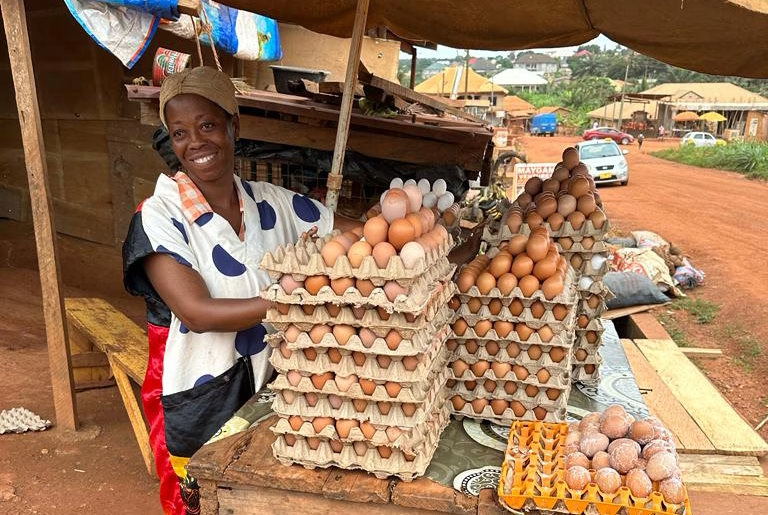
From the very beginning of her life, Teresa faced circumstances beyond her control – birthplace, family, and gender – which marked her for exclusion. Each day was a struggle, with basic necessities often out of reach. Economic opportunities were rare, and the effort to earn a small income took a toll on her emotionally and physically. Teresa’s story mirrors the stories of countless clients we serve and reminds us of the urgent need for change. As we step into a new year, Opportunity International remains passionately focused on alleviating poverty through financial inclusion for lives like Teresa’s.
What is Financial Inclusion?
Today, over 1.4 billion people, more than half of the global working adult population, lack access to financial services. At its core, financial inclusion ensures that individuals, regardless of their socio-economic background, have access to loans, savings, insurance, and support. This involves a comprehensive strategy which invites individuals into a formal system, offering opportunities that can break the cycle of generational poverty and build a better life for families.
Imagine a new narrative where Teresa receives a microloan to start a small business, gain access to a savings account, and the support to improve financial literacy. She begins to provide a better life for her children, including ensuring they receive an education. The cycle of poverty is replaced with a new cycle of transformation, where Teresa’s family is no longer marginalized and has the opportunity to thrive.
Increasing Access to Financial Inclusion
Lack of access to financial services is particularly pronounced in developing countries, where approximately 80% of those living in poverty are excluded from financial services.
Microfinance is a powerful starting point in driving sustainable change in these communities. It involves providing small loans to those traditionally excluded from formal banking.
For Teresa, it began with a microloan of just $85 USD, which enabled her to start selling eggs on the street – just what she needed to kickstart her business.
Beyond providing access to capital, financial inclusion invites individuals into a system where they can not only access loans but also save and secure insurance.
In several countries that Opportunity works in, this is fostered through Savings Groups. These are community groups of approximately 20 clients, usually women. Groups meet weekly to make a deposit and learn new skills. Deposits are kept in a secure box requiring three keys, each kept by a different Savings Group leader. Funds can be lent out to members earning interest revenue for the group. At year-end, proceeds can be paid or reinvested in the next round.
In these groups, members learn the importance of saving a small amount of their weekly income. They can borrow from the fund to meet a household need or invest in their businesses. Here, they receive ongoing training, build new life skills, increase their financial literacy, learn how to run a small business, and gain confidence.
Now a contributing member of a community, they begin to break from generations of marginalization and thrive.
For Teresa, this support enabled her to transition from carrying eggs on her head to setting up the roadside stall which she now operates.
Removing Barriers to Financial Inclusion
Teresa’s story is a picture of the challenges faced by individuals, especially women, who are trapped in the cycle of poverty. Their circumstances are compounded by barriers that result in a lack of access to essential resources. Born into worlds where doors are often closed to women, they face an uphill battle, with economic opportunities remaining distant dreams.
At Opportunity International Canada, we’re committed to addressing disparities and removing these barriers. Recognizing that empowering women entrepreneurs is a catalyst for broader community transformation, we support programs that invest in women entrepreneurs.
By providing tailored financial products, educational resources, and mentorship opportunities, we can level the playing field and break down the barriers that hinder women from realizing their full potential.
Teresa’s story took another remarkable turn as she transitioned from mentee to mentor in a Women’s Mentorship Program. As a mentor, Teresa now provides the support and guidance that she once received to two others on their journey towards financial empowerment.
In many marginalized communities, lack of infrastructure and geographic remoteness create barriers that prevent individuals from participating in the formal financial system.
In an era where technology is advancing at an unprecedented pace, leveraging digital solutions becomes vital in reaching marginalized communities and fostering economic empowerment.
As we embrace the opportunities that come with the new year, technology becomes even vital in connecting with remote areas. Our high-touch, high-tech digital solutions bridge the gap, ensuring even the most rural communities have access to the tools and resources they need.
Teresa’s story paints a vivid picture of what is possible when microfinance, education, and support converge to ignite a cycle of transformation. Through a modest microloan, Teresa doesn’t just start a business; she begins rewriting a new narrative for her family. Not only has she changed the future for herself, but also her daughter who is studying nursing.
Her journey exemplifies the transformative power of financial inclusion in breaking the cycle of poverty.
As we break down barriers and uplift communities for a more inclusive future, people like Teresa become a beacon of hope for all those on their journey out of poverty. Marginalized no more, they embark on a journey toward a better life filled with dignity, purpose, and the opportunity to achieve their dreams, ensuring a brighter more inclusive future ahead.